01
Inconsistent documentation
Consent language can vary across physicians, templates, locations, disease sites, and treatment techniques.
An automated system for building robust, relevant, patient-specific consent forms inside existing radiation oncology workflows without adding extra work for clinicians.
Radiation Oncology Consent Builder helps assemble disease-site-specific, modality-aware consent documentation from the clinical context already present in the radiation oncology workflow.
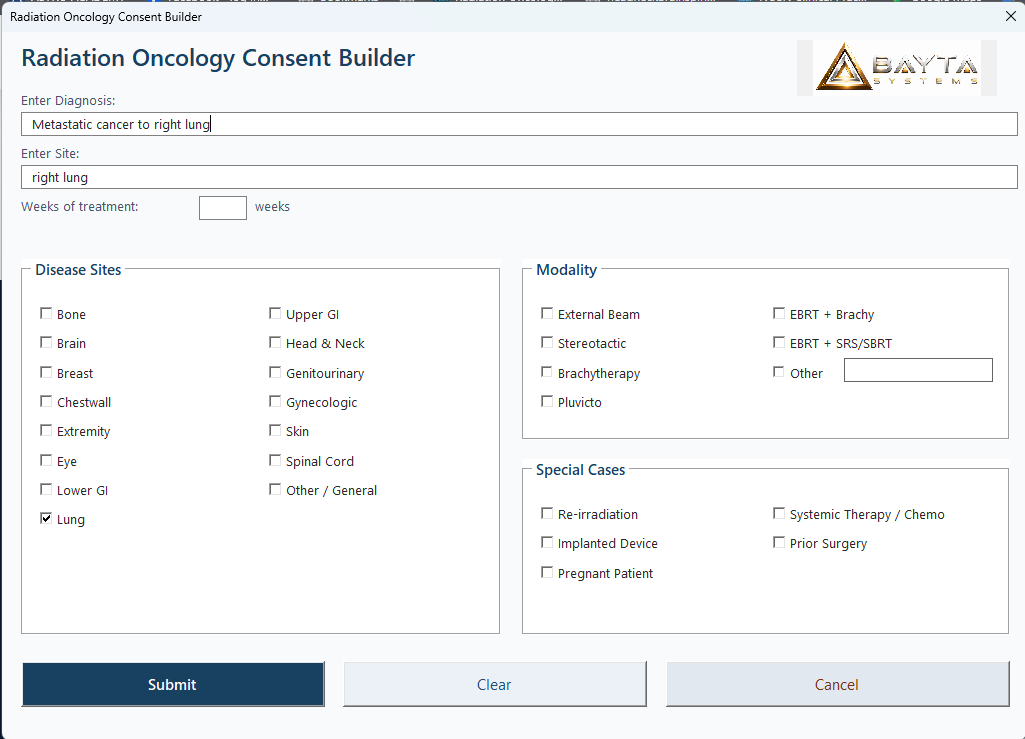
Clinical context, modality, special cases, and site-specific language are organized for physician review.
Built for radiation oncology physicians, cancer centers, hospitals, and compliance-minded clinical teams.
Radiation oncology consent discussions are clinically nuanced, disease-site specific, and often documented under time pressure. Yet many consent processes still depend on generic procedural forms, fragmented templates, manual editing, or physician memory. That creates a predictable gap between the complexity of modern radiation oncology and the reliability of the documentation workflow.
Consent language can vary across physicians, templates, locations, disease sites, and treatment techniques.
Physicians repeatedly recreate, remember, or customize language for common and high-risk clinical scenarios.
Breast, brain, lung, GI, GU, gynecologic, skin, SBRT/SRS, brachytherapy, and re-irradiation each require different considerations.
Generic consent workflows may miss radiation-specific risks, special scenarios, alternatives, or late effects.
The Consent Builder lives inside radiation oncology documentation workflows and turns consent generation into an automated, structured assembly process. Clinical context and special scenarios drive relevant language, while the physician remains in control of review, editing, and the final consent discussion.
Including disease site, diagnosis, laterality, site, and more.
Re-irradiation, implanted devices, pregnancy, systemic therapy, prior surgery, SBRT/SRS, or brachytherapy.
Robust and relevant consent documentation is assembled for physician review, editing, and finalization.
Radiation treatment varies by disease site, technique, prior treatment, and patient-specific factors. But many consent workflows still rely on generic forms, manual edits, or hard-to-read templates. Published work shows wide variation in radiotherapy consent practices, limited use of body-site-specific forms, readability problems, and patients who later wish they had been told more about side effects.
The Consent Builder helps close that gap by automatically assembling relevant consent language inside the natural radiation oncology workflow, while keeping the physician in control of the final discussion and documentation.
of responding U.S. academic radiation oncology departments reported using body-site-specific radiotherapy consent forms in a national analysis.
of analyzed radiotherapy consent forms met an eighth-grade readability target in the same study.
of surveyed U.S. adults treated with radiation felt inadequately informed about expected adverse effects.
Structured consent content by clinical site and scenario.
Support for EBRT, SBRT/SRS, brachytherapy, EBRT plus brachytherapy, Pluvicto, and custom modalities.
Visibility for re-irradiation, implanted devices, pregnancy, prior surgery, and systemic therapy.
Designed to support, not replace, clinical judgment and patient-specific counseling.
Consent language can be adapted to institutional standards and departmental review.
Central updates as policies, technologies, or disease-site workflows evolve.
Can begin in familiar documentation environments without a full enterprise EHR build.
Architecture can evolve toward EHR integration, APIs, audit trails, analytics, or cloud workflow.
The Consent Builder supports structured radiation oncology documentation that can be reviewed against CMS Conditions of Participation, Joint Commission informed-consent expectations, institutional policy, medical staff governance, risk-management review, and radiation-oncology-specific documentation standards.
Final implementation should be reviewed and approved under each institution's informed-consent policy, medical staff bylaws, legal requirements, and compliance procedures.
Helps identify the intended radiation treatment, site, laterality when relevant, technique, and clinical context.
Supports consistent disease-site-specific language for relevant acute, late, common, serious, and site-specific risks.
Can include alternatives such as observation, systemic therapy, surgery, palliative care, supportive care, or no treatment when appropriate.
Supports documentation that the patient had the opportunity to ask questions, received understandable information, and agreed to proceed.
Can prompt interpreter use, surrogate decision-makers, translated materials, and communication accommodations when applicable.
Supports a finalized consent document suitable for inclusion in the medical record before treatment begins, consistent with local policy.
Built around commonly expected informed-consent domains, including federal medical-record expectations and hospital accreditation standards. CMS medical record Conditions of Participation and Joint Commission informed-consent requirements.
The Consent Builder is a cost-effective way to standardize consent documentation without launching a large new enterprise system. It is designed around the natural workflow of modern radiation oncology: familiar documentation environments, physician review, local customization, and a practical path toward deeper integration over time.
Begin with document-based workflow while preserving a path to more advanced integrations.
Standardize a high-value clinical process without requiring a major EHR build or disruptive implementation.
Consent language can be reviewed and updated by departmental leadership.
Institutions can adapt language to approved consent standards and legal review.
We created the Consent Builder because informed consent in radiation oncology is too important to depend on inconsistent free-text habits, generic procedural forms, fragmented templates, or memory alone. Radiation oncologists routinely manage complex treatment sites, techniques, re-irradiation histories, systemic therapy, implanted devices, pregnancy-related considerations, and late-effect counseling.
Bayta Systems builds practical oncology workflow software. The goal here is simple: make it easier for radiation oncology teams to produce clear, consistent, clinically relevant, patient-specific consent documentation without slowing down care or forcing clinicians into a separate workflow.
Available for physician groups, hospital-based radiation oncology departments, and cancer programs interested in standardizing consent workflows.